
There's a question that has puzzled neuroscientists for decades: why do some people always seem to have the right answer at the right moment — while others, just as smart and just as hard-working, keep tripping over the same obstacles? The answer began to take shape in a lab, decades ago, when a researcher noticed something that would change how we understand the human mind.
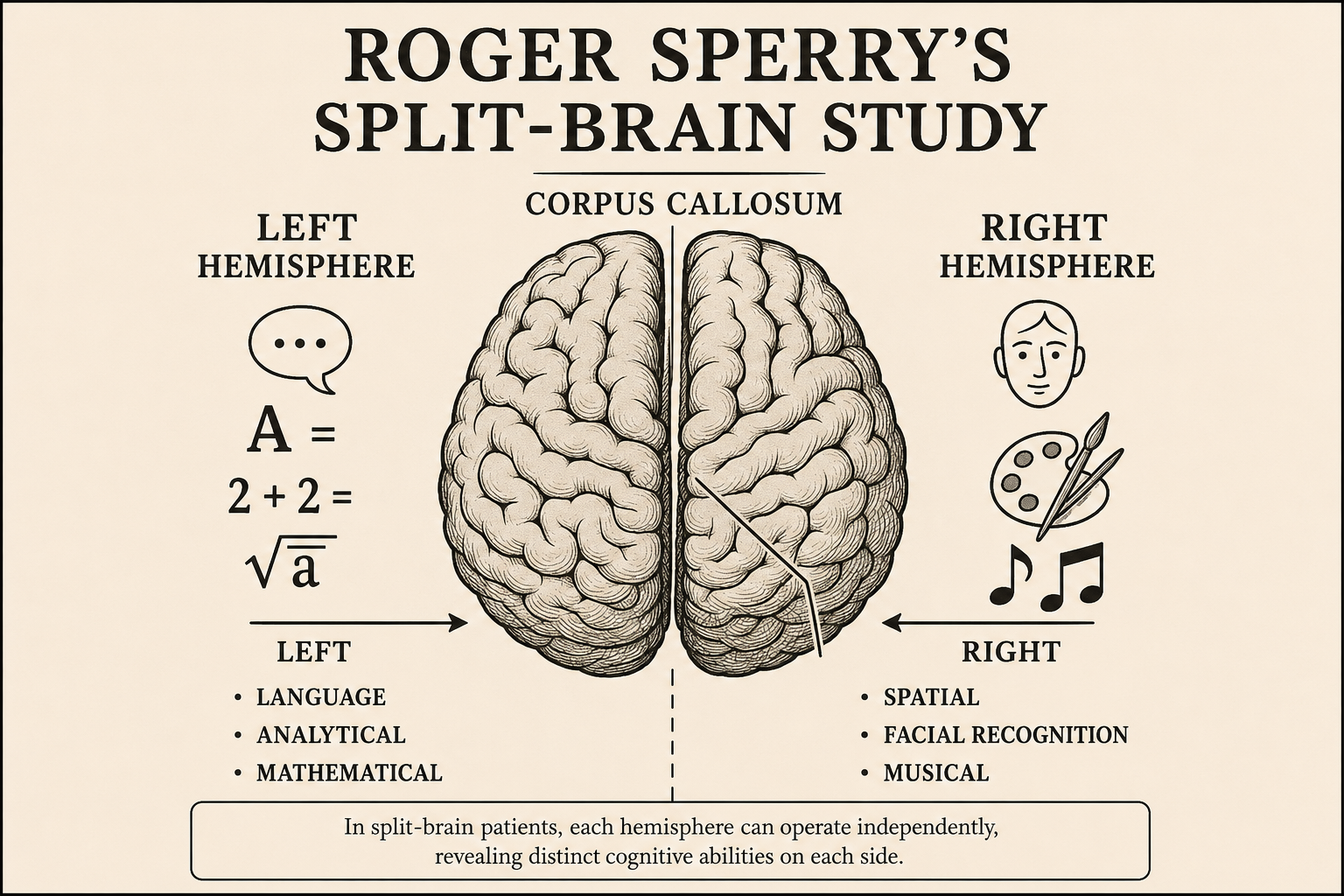
 Roger W. SperryHis name was Roger Sperry. And what he discovered about the brain's two hemispheres was significant enough to win him the Nobel Prize.
One brain, two halves, one shared potential
Sperry showed that the brain's two hemispheres can operate in isolation — or they can operate in sync, "talking" to each other in real time. And when that happens, something shifts. People report more clarity, an easier time learning, and above all: insights that seem to simply "show up" at the right moment.
Curiously, that exact pattern of activity shows up far more often in scans of children than in scans of adults.
It's as if, somewhere along the way to adulthood, something gets gradually switched off. The obvious question — and the one that most intrigued researchers — was: what exactly happens between childhood and adulthood that causes this shift?
The real cost of a switch left off
For anyone living this out day to day, the signs are familiar, even without a scientific explanation on hand: the sense that good ideas always arrive too late, the feeling of always being one step behind — in your career, your finances, even your relationships.
Here's what a few people noticed once that connection started coming back online:
"I felt like life was just happening to me — nothing I tried seemed to work. Within 10 days, something shifted. It felt like years of invisible stress just melted away, and even my marriage feels different now."
"By week two, my wife was joking that I seemed sharper. My online store has grown enough that we're planning a trip to Disney Tokyo with the kids."
"My family always joked we had bad luck. That finally feels like it's changing — the romance came back at home, and an idea I had at work out of nowhere got me promoted."